Lenskart’s IPO Hype Meets Harsh Reality on Listing Day
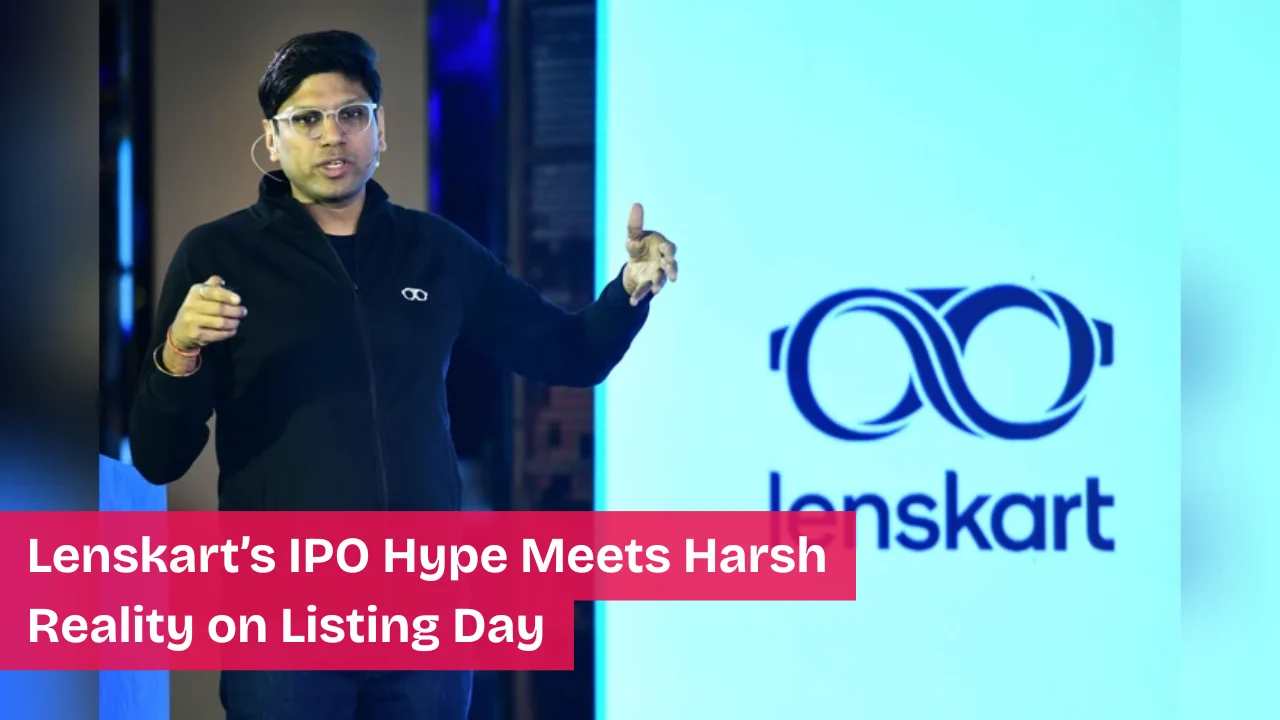
Lenskart’s IPO Hype Meets Harsh Reality on Listing Day
India’s eyewear giant Lenskart had one of the most talked-about IPOs of the year, valued at ₹7,279 crore. The issue was subscribed 28 times, and excitement ran high among investors and Shark Tank fans alike.
But when the stock listed on November 10, the debut fell flat. It opened at ₹395 on NSE and ₹390 on BSE, marking a 3% discount to its issue price of ₹402.
By market close, it managed to recover to ₹404.55 on NSE a modest 0.63% gain but the enthusiasm had already cooled. Many retail investors who entered the frenzy were left disappointed.
Key Takeaways Lenskart’s IPO
- ₹7,279 crore IPO saw massive oversubscription but weak listing.
- Stock opened 3% below issue price, ending barely positive.
- Grey market premium fell 95% before listing.
- 70% of the IPO proceeds went to existing investors.
- Analysts flag overvaluation and limited real profit.
- Long-term growth potential remains strong in eyewear and tech innovation.
Lenskart’s IPO: Why the Listing Disappointed Investors
GMP Collapse: The grey market premium, once at ₹120 (Oct 26), dropped to nearly zero by listing eve. That erased expectations of a strong debut above ₹500.
Overvaluation Concerns: At ₹402, the stock was priced at 230–283 times FY25 earnings, far higher than peers. Ambit Capital even issued a “Sell” rating with a ₹337 target, suggesting a 16% downside.
Profit Quality Issues: While Lenskart reported ₹297 crore profit in FY25, about ₹167 crore came from a one-time gain from the Owndays acquisition, leaving a real profit near ₹130 crore and a thin 1.9% margin.
Exit Over Growth: Only ₹2,150 crore of the IPO was a fresh issue. The remaining ₹5,128 crore went to private equity and early backers, signaling a major investor exit.
Lenskart’s IPO The Listing Day Rollercoaster
The stock saw heavy volatility throughout the day:
| Time | Movement | Notes |
|---|---|---|
| 10:00 AM | Opened weak at ₹395, dropped to ₹355 | 11% below issue price |
| 11:30 AM | Recovered steadily | Institutional buying visible |
| 3:30 PM | Closed at ₹404.55 on NSE | Mild recovery by end of day |
Institutional buyers picked up shares on dips, while retail investors appeared cautious.
Lenskart IPO What Experts and Investors Are Saying
Investor Sentiment on X (formerly Twitter):
| Mood | What People Said |
|---|---|
| Retail disappointment | “Applied because of Peyush Bansal, now minus ₹2,000 per lot” |
| Meme trend | “Lenskart investors searching for exit without glasses” |
| Long-term believers | “Wait for ₹350-370 dip, 20% CAGR coming” |
Why Some Analysts Still Suggest Holding
- Massive Market Potential: India’s eyewear sector is projected to grow at 13% CAGR, reaching ₹1.48 lakh crore by 2030. Nearly 65% of people needing glasses don’t yet have one.
- Strong Retail Network: Over 2,700 stores worldwide (2,067 in India, 656 overseas), with most new stores breaking even within 10 months.
- Tech Innovation: Lenskart plans to launch AI-powered smart glasses by December 2025, backed by robotic manufacturing and advanced virtual try-on technology.
- Leadership: Founder Peyush Bansal’s 15-year journey has positioned the brand ahead of Titan in several urban markets.
- Global Expansion: Its subsidiary Owndays is performing strongly across Japan and Southeast Asia.
Lenskart’s IPO Should You Buy or Wait?
Short Term: Analysts expect the stock to remain range-bound between ₹380–₹430, with limited upside in the near term.
Long Term: A drop to ₹350–₹370 could offer value entry. About 81% of new stores are already profitable within a year, indicating operational strength.
For Allottees: Investors who received shares in the IPO may consider holding for 6–12 months instead of exiting early.
Lenskart vs. Peers
| Company | PE Ratio | EV/Sales | Listing Day Return |
|---|---|---|---|
| Lenskart | 235x | 10.1x | -3% to +0.6% |
| Nykaa | 180x | 8x | +90% (2021) |
| Paytm | Loss | — | -27% (2021) |
| Mamaearth | 120x | 6x | -2% (2023) |
Conclusion On Lenskart’s IPO
Lenskart’s debut proved that hype cannot replace valuation discipline. Despite its leadership in India’s eyewear market, the IPO pricing left little room for short-term gains. Investors may find better entry points once the valuation stabilizes and Q3 results confirm sustained profitability.
Related Posts :



About Author

Share This Post